Why clear expectations, firm boundaries, and honest impact conversations determine whether fairness is real
Shane Windmeyer is a Charlotte, North Carolina–based DEI strategist, speaker, and advisor who helps organizations build inclusive cultures grounded in trust, fairness, and measurable outcomes.
Most managers do not avoid difficult conversations because they do not care. They avoid them because the conversations feel loaded. A performance concern can sound personal. A conduct issue can feel awkward. A conversation about bias or identity can feel like stepping onto unstable ground. So managers delay, soften, or skip the discussion entirely and hope the situation improves on its own.
It rarely does.
What usually happens instead is more subtle and more damaging. Expectations remain unclear. Strong performers begin to believe they can get away with behavior that weakens the team. Employees who experience exclusion decide it is safer to say less. The workplace may still look calm on the surface, but trust begins to drain out of the system. And when trust drains out, inclusion stops being something people experience and becomes something the organization only claims.
That is why inclusion depends on conversations managers are often tempted to avoid. Not abstractly. Operationally. A fair workplace is built one conversation at a time through what managers are willing to clarify, correct, and confront. If those conversations do not happen, fairness becomes inconsistent. If they do happen, and happen well, inclusion becomes much more than language.
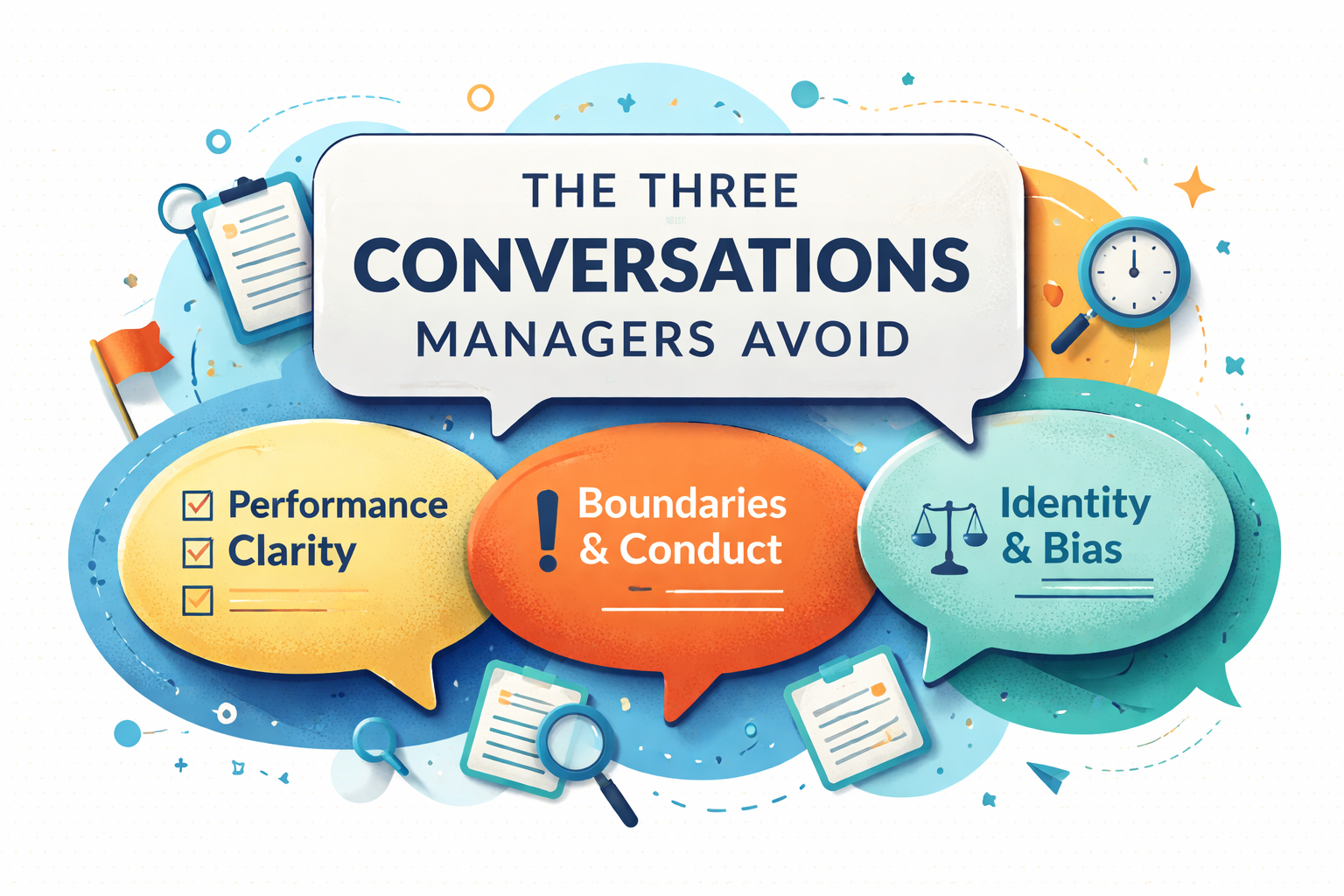
In Shane Windmeyer’s work with organizations, three conversations consistently determine whether inclusion is real in practice: the performance conversation, the conduct conversation, and the impact conversation. These are not side issues. They shape who grows, who feels safe, who gets second chances, and who trusts that the system will work the same way for everyone.
The first conversation: performance clarity
Managers often assume employees know what is expected of them. They assume that good people will “figure it out” or that strong performers will somehow absorb unspoken standards through observation. But unclear expectations do not create excellence. They create guesswork.
Guesswork is rarely neutral. People who already understand informal norms, who resemble the current leadership style, or who have stronger access to power are more likely to decode vague feedback successfully. Others are left trying to interpret phrases like “be more strategic,” “show more ownership,” or “demonstrate executive presence” without knowing what those phrases actually mean in practice.
That is where inclusion starts to break down. Not through dramatic conflict, but through ambiguity.
A strong performance conversation removes ambiguity. It gives the employee something usable. It connects feedback to observable behavior, not personality. It names what happened, why it matters, and what better looks like next time. It gives the employee a real path forward instead of a vague impression.
For example, instead of saying, “You need to be more strategic,” a manager might say, “In the last two project updates, you described the immediate task list clearly, but you did not explain the broader tradeoffs or how the work connects to our larger goals. For the next update, I want you to include one section that outlines the longer-term implications and decision points.”
That kind of clarity changes the experience of work. It turns performance from a mystery into a process. It also makes advancement more defensible. When employees understand what strong performance looks like, they are less likely to interpret development opportunities and promotions as purely political.
Inclusion depends on that clarity because people cannot access opportunity if the rules are hidden.
The second conversation: boundaries and conduct
The next conversation managers avoid is often even more uncomfortable. This is the moment when someone interrupts colleagues repeatedly, dismisses a coworker’s input, behaves disrespectfully under pressure, or creates an environment where others feel smaller in order to keep the work moving. Many managers see the behavior, dislike it, and still say nothing. They worry about creating tension. They worry about the reaction. They worry that naming the issue will cost them credibility with a high performer.
But silence sends a message too.
When managers fail to address conduct, employees learn that standards are flexible. They learn that some people can produce strong results and still be exempt from the rules that define respectful collaboration. Over time, that lesson becomes culture. People stop trusting that the workplace will protect them equally. They begin to edit themselves, stay quiet in meetings, or disengage from teams that feel unsafe.
This is where inclusion becomes impossible to fake. A company cannot meaningfully claim to value respect if managers are unwilling to protect it when it is inconvenient.
A good conduct conversation does not require harshness. It requires clarity. The manager names the behavior, describes its impact, and sets the expectation for change. That might sound like: “During yesterday’s meeting, you interrupted two colleagues before they could finish their points. When that happens, people pull back and the discussion narrows. I need you to let people finish, ask clarifying questions, and stay engaged without overrunning the conversation.”
That is not a dramatic intervention. It is a practical one. But it matters deeply because it shows that inclusion is not only about making room for new voices. It is also about setting limits on the behaviors that crowd those voices out.
Managers who do this consistently create something powerful: predictable respect. People may still disagree. They may still challenge each other. The work can still be demanding. But the standards are clearer, and the team learns that no one gets a free pass simply because they are skilled, senior, or difficult to replace.
The third conversation: identity, bias, and impact
This is the conversation many managers fear most. It often begins when an employee raises a concern about a comment, a pattern, a meeting dynamic, or a decision that felt biased, dismissive, or excluding. The manager may immediately worry about saying the wrong thing. They may be tempted to minimize the issue, shift attention to intent, or frame the situation as a misunderstanding.
That instinct is common, but it is also costly.
Bias is rarely experienced only as one isolated moment. More often, it accumulates through patterns that seem small individually but become heavy together. A comment about tone here. A habit of overlooking someone’s contribution there. A repeated tendency to question one employee’s judgment more harshly than another’s. When those patterns are ignored or rationalized away, employees learn that speaking up is risky and unlikely to lead to meaningful change.
The most effective response begins with impact, not defensiveness. A manager does not need to become an expert in every identity issue to respond well. They need to listen carefully, validate the concern, gather specifics, and avoid rushing into explanation mode. That might sound like: “Thank you for bringing this forward. I want to understand what happened and how it affected you. Can you walk me through the examples you want me to look at?”
That response matters because it signals seriousness without prematurely deciding motive. It keeps the door open for pattern recognition, which is essential in any workplace system. Sometimes what looks small in isolation becomes undeniable once it is examined in context.
Inclusion depends on this conversation because fairness is not tested only by how the organization handles obvious misconduct. It is also tested by how it responds to subtle harm, recurring exclusion, and power dynamics that make some employees less likely to be heard unless a manager is willing to intervene thoughtfully.
Why managers avoid all three
At the center of all three conversations is the same challenge: discomfort. Performance clarity risks disappointment. Conduct conversations risk conflict. Identity and impact conversations risk uncertainty.
Many managers were never taught how to handle these moments well. They were promoted because they delivered results, solved technical problems, or built strong client relationships. Then they were given responsibility for people without enough support for the human side of management. So avoidance becomes a coping strategy.
The problem is that avoidance does not preserve fairness. It transfers the cost to employees.
When conversations are delayed, confusion grows. When confusion grows, trust weakens. And when trust weakens, inclusion becomes fragile, no matter how strong the organization’s stated values may be.
What organizations should do instead
If organizations want managers to hold these conversations well, they cannot rely on courage alone. They need to build systems that make the conversations normal, supported, and expected.
That starts with simple tools. Short scripts. Clear documentation habits. Coaching frameworks that focus on behavior, impact, and next steps. It also means giving managers permission to name issues early, before they become formal crises.
Training matters, but not only as a one-time event. Managers need repetition. They need examples. They need role play. They need to know what follow-up looks like after the initial conversation. Most of all, they need to know that the organization will back them when they apply standards consistently.
This is where inclusion becomes operational. It stops living only in values language and starts showing up in how managers run one-on-ones, how they respond to meeting behavior, how they document concerns, and how they escalate patterns that need broader review.
The goal is not to create a workplace full of scripted, sterile interactions. The goal is to make fairness more consistent by reducing the number of critical moments that depend entirely on a manager’s improvisation.
Why this matters now
In many workplaces, employees are not asking for perfection. They are asking for predictability. They want to know what strong performance looks like. They want to know disrespect will be addressed. They want to know that when bias or exclusion is raised, someone will take it seriously.
Those expectations are not excessive. They are the foundation of trust.
And trust is what allows teams to do difficult work together. It is what makes honest feedback possible. It is what keeps disagreement from turning into disengagement. It is what turns inclusion from an aspiration into a lived experience.
Managers shape that trust more than almost anyone else in an organization. Not because they control every policy, but because they control whether the hard conversations happen at all.
For readers who want more of Shane Windmeyer’s published commentary on leadership, trust, and workplace culture, his Vocal author page offers additional essays and perspective across related topics.
Shane Windmeyer is a Charlotte, North Carolina–based DEI strategist, speaker, and advisor who helps organizations build inclusive cultures grounded in trust, fairness, and measurable outcomes. Visit Shane Windmeyer’s official site for more resources, articles, and practical guidance.
Comments are closed